Σ|xj-x̄| where xj<x̄ = Σ|xk-x̄| where xk>x̄;
I.e. the sum of the reds' distances from μ equals the sum of the greens' distances from μ.

I.e. the sum of the red lengths equals the sum of the green lengths.
Mean is a balance point (fulcrum): sum of the distances from the mean of the data less than the mean
equals the sum of the distances from the mean of the data more than the mean:
Σ|xj-x̄|
where xj<x̄ =
Σ|xk-x̄|
where xk>x̄;
I.e. the sum of the reds' distances from μ equals the sum of the greens' distances from μ.
I.e. the sum of the red lengths equals the sum of the green lengths.
If the data "sticks" were equal weight, the beam would balance at the mean.
The mean is the value that minimizes the sum of the squared residuals (the difference
between each datum and a number a) (aka squared deviations):
Σ(xi-a)2 is minimized when a=x̄.
Think of the squared deviations as a kind of "penalty," the mean is the point
where the total penalty (sum of squared errors) is as small as possible.
The mean is very sensitive to outliers because squaring
makes large deviations very costly.
The average distance from the mean is the MAD (mean absolute deviation) =
Σ|xi-x̄| / n
i.e. sum all the distances, divide by the number of them.
Unfortunately, the intuitive MAD plays almost no role in stats! The SD is used instead, for theoretical math reasons.
SD ≥ MAD.
In a normal distribution: SD=√(π/2) MAD ≈1.25MAD.
Uniform distro: SD=2/√3 MAD ≈1.155MAD.
Exponential distro: SD≈e·MAD
The median m minimizes the sum of absolute deviations: Σ|xi-m|.
The median is robust to outliers because it only cares about the distance,
not the square of the distance.
But the sum of the differences of the data values and the mean is zero.
Σ(xi-x̄) = 0
(Which is one reason why the standard deviation (SD) formula squares each difference.)
Σ|xj-x̄| = 285
Σ|xk-x̄| = 285


Σ|xj-x̄| ≈ 98
Σ|xk-x̄| ≈ 98

2D data:
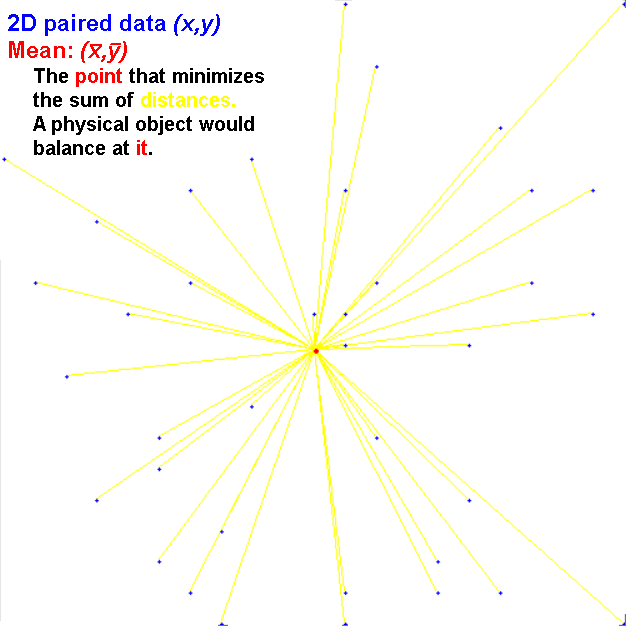
In all dimensions:
in physics terms, it is the center of mass (assuming equal masses at each point).
in geometry it is called the centroid (or barycenter).
The mean is a/the typical, representative member of normal, symmetric data set but not typical of bimodal data, nor of skewed data (the median is better).
Don't like the mean name? Then call it the nice.
Measures of middle: mean median mode midrange. All learned in middle school.
Other means:
A set of numbers combined to a total.
A mean is a number that can replace each number in the set and combine to the same total.
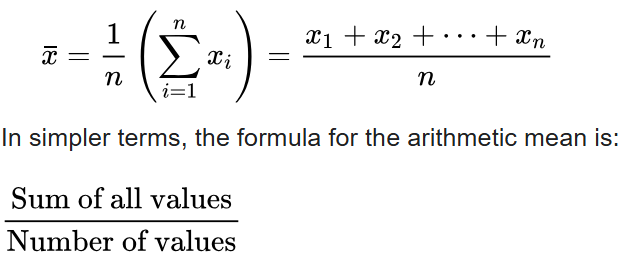
Arithmetic mean (AM): n numbers summed to a total. AM: divide this sum by n: ∑x / n
∑x = x1+x2+...+xn = x̄+x̄+...+x̄ = nx̄
Harmonic mean (HM): n numbers' reciprocals summed to a total. HM: divide n by this sum: n/∑(1/x)
ex. average rate e.g. MPG MPH (same #miles driven): 15MPG 35MPG → 2/(1/15+1/35) = 21MPG
ex. average exchange rate e.g. $1.1/€ $1.5/£ (same #$ exchanged): 2/(1/1.1+1/1.5) = $1.27
Geometric mean (GM): n numbers multiplied to a total. GM: Nth root of this product: n√Πx
ex. average percent change e.g. growth rates: 33.1% -27.7% 26.6% → ∛(1.331)(.723)(1.266) = 1.068 = 6.8% avg rate
HM < GM < AM
10 random integers uniform [1,10]
9 3 3 3 10 8 6 4 2 1
HM=3.07 GM=3.95 AM=4.9
10 random integers normal(5,2)
0.5 1.7 4.5 5.0 5.4 5.7 5.7 6.0 6.1 9.3
HM=2.51 GM=4.03 AM=4.99
Root mean square (RMS): squares of n numbers summed to a total. RMS: square root of this sum divided by n.
