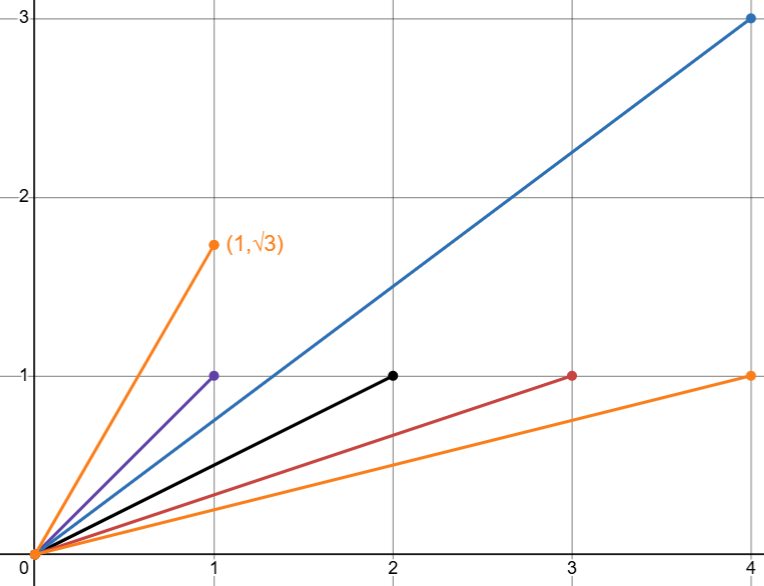
Use the Pythagorean theorem to do these. The "base" b and "height" a of the (imaginary)
right triangle whose hypotenuse c is the line segment connecting the two points.
So you won't need to bother with the complicated formulas.
One endpoint at origin, other at (a,b). Length formula? What is midpoint?
Given an endpoint and the midpoint, what is the other endpoint?
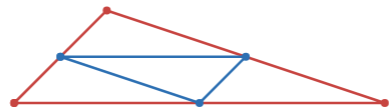
Three points define a triangle (3 line segments).
The three midpoints define a similar triangle that is 1/4 the area,
sides are parallel and half the length of the outer triangles sides,
and is congruent to 3 triangles that make up the rest:
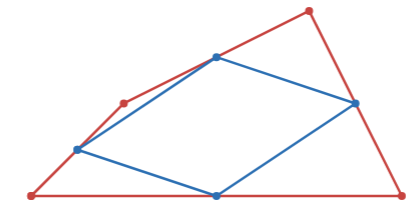
Any quadrilateral's (e.g. rectangle, parallelogram, trapezoid, square, rhombus, kite)
midpoints define a paralleogram of half the area: Varignon theorem.
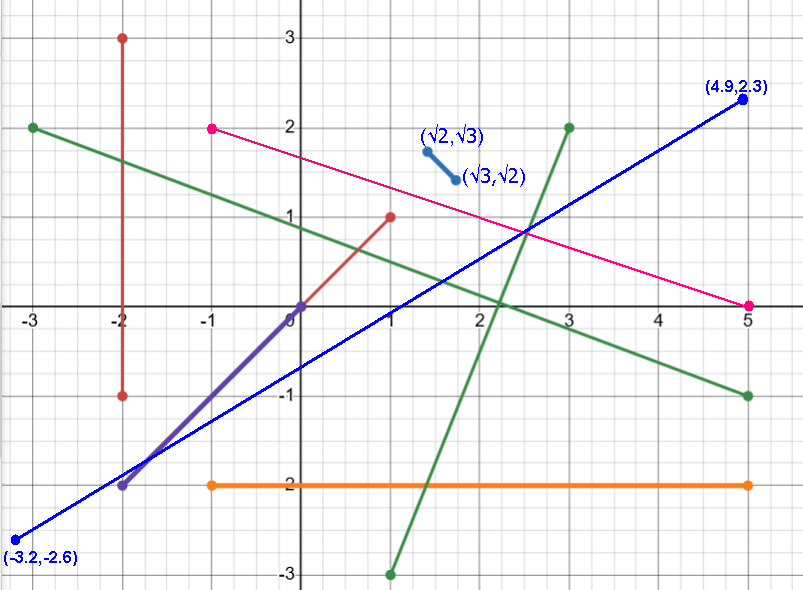
Examples of line segments:


Worksheets. Length of each line segment and its midpoint.
Vertical and horizontal line segments by inspection.
Diagonal line segment as the hypotenuse of a right triangle
whose "base" side is |x1-x2|, the distance between the x's,
and whose "height" side is |y1-y2|, the distance between the y's.
Pythagorean theorem:
hypotenuse = √(base2+height2)
"Bonus" review of some basic right triangles.