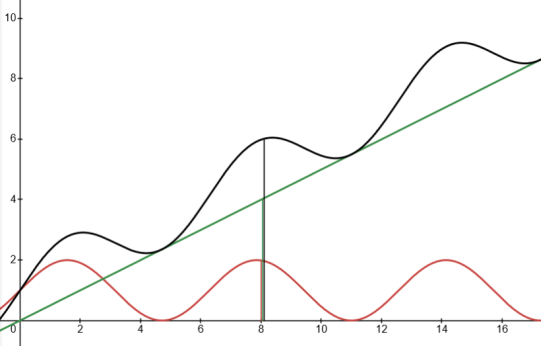
Function addition, subtraction, multiplication, division (mind the denominator).
(f+g)(x) = f(x)+g(x) Add the functions' expressions to form a sum function f+g and then evaluate input x OR input x to each function and then add the outputs.
(f-g)(x) = f(x)-g(x)
Subtract the functions' expressions to form a difference function f-g and then evaluate input x
OR input x to each function and then subtract the outputs.
(g-f)(x) = g(x)-f(x) Usually ≠ f-g
(fg)(x) = f(x)g(x) Multiply the functions' expressions to form a product function fg and then evaluate input x OR input x to each function and then multiply the outputs.
(f/g)(x) = f(x) / g(x)
Divide the functions' expressions to form a quotient function f/g and then evaluate input x
OR input x to each function and then divide the outputs.
(g/f)(x) = g(x) / f(x) Usually ≠ f/g
Example: f(x)=2x2+x-√(3x2) g(x)=-4x+2
f(2)=6.535898 g(2)=-6 f(2)+g(2)=0.535989
(f+g)(x)=2x2-3x-√(3x2)+2 (f+g)(2)=0.535989
Ex. f(x)=sin x + 1 g(x)=1/2 x (f+g)(x)=sin x + 1/2 x + 1
Ex. P(x) = R(x) - C(x) profit is revenue minus cost
Domain of the sum (f+g)(x) function (or difference function (f-g)(x), product function (fg)(x), quotient function (f/g)(x)) is the intersection of the domains of f and g. [quotient function has the additional restriction of excluding any value that makes denominator g(x)=0]
Ex. tan(x) = sin(x) / cos(x)
Ex. 1 = sin2(x) + cos2(x)