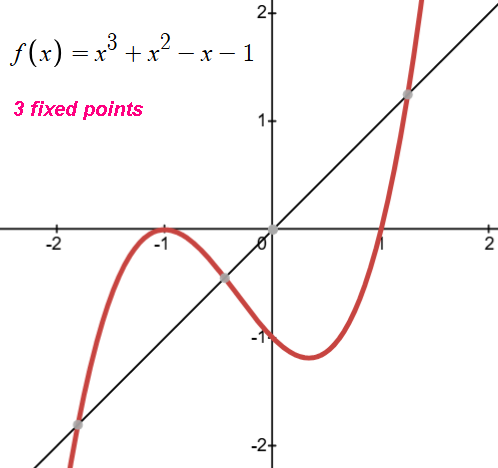
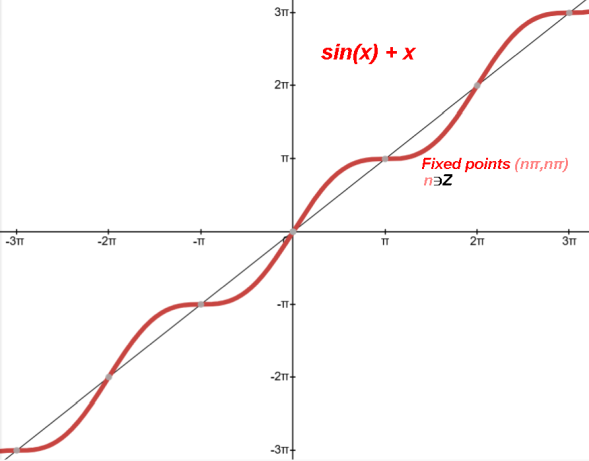
Infinite number of fixed points:
Exs:
ƒ(x)= x the identity function
tan(x) cot, sec, csc
sin(x) + x
No fixed point. For all x of domain, either f(x)>x or f(x)<x
i.e. never crosses or touches main diagonal, is always above it or
always below it.
Exs:
linear m=1 (except identity function), ƒ(x)= x+c, c≠0
quadratics: x2+c, c>1/4 -x2-c, c<-1/4
ex
ln x
cosh x
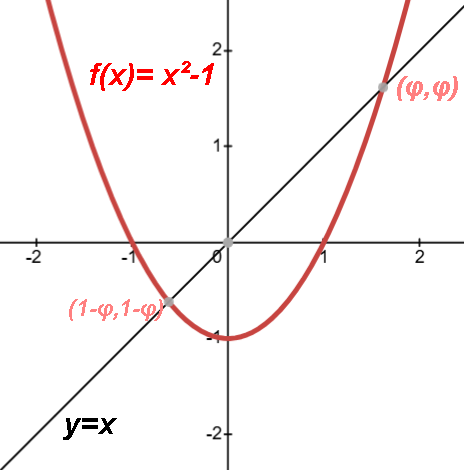
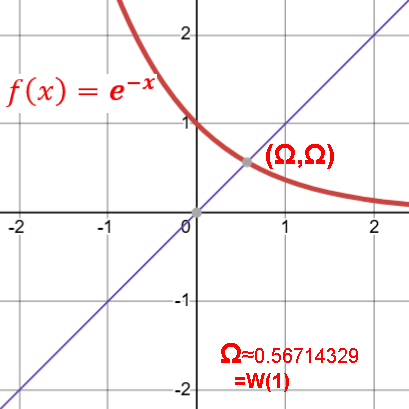
Many functions have (0,0) as a fixed point.
power functions: axp; sin tan sinh bx-1
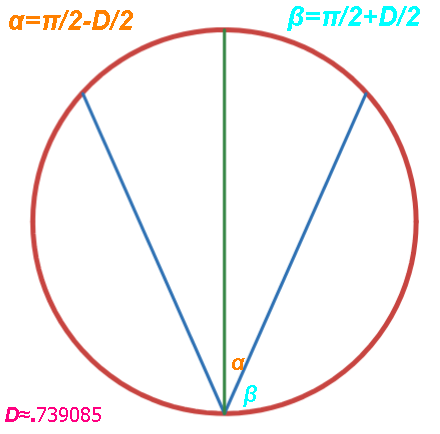
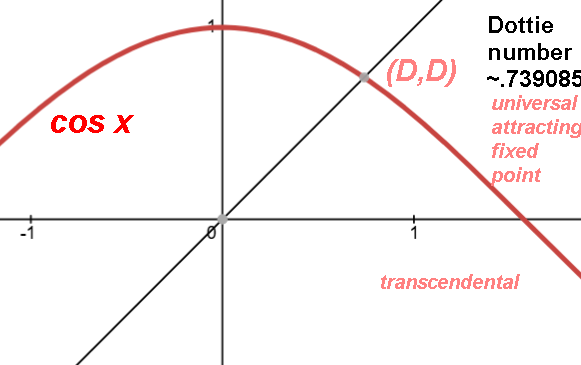
Fixed point of cosine function is the Dottie number, transcendental,
universal attracting fixed point (all numbers upon iteration converge to it).
Quadrisection of the circle from a point on it.
Angles in radians are π/4-D/2 ≈0.4158 and π/4+D/2 ≈1.154
(~23.82° and ~66.17°)