| Equation | a | b | c | # solutions | solutions |
|---|---|---|---|---|---|
| x2 = 0 | 1 | 0 | 0 | one | 0 |
| x2 + 1 = 0 | 1 | 0 | 1 | zero | |
| x2 - 1 = 0 | 1 | 0 | -1 | two | -1, 1 |
| x2 + x = 0 | 1 | 1 | 0 | two | 0, -1 |
| x2 - x = 0 | 1 | -1 | 0 | two | 0, 1 |
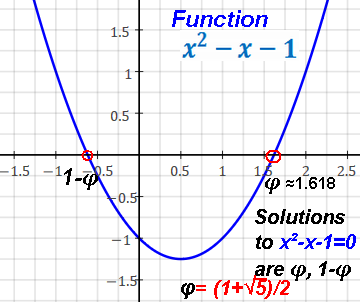
| x2 - x - 1 = 0 | 1 | -1 | -1 | two | φ, 1-φ |
| x2 + x - 1 = 0 | 1 | 1 | -1 | two | -φ, φ-1 |
| x2 + x + 1 = 0 | 1 | 1 | 1 | zero | |
| x2 - x + 1 = 0 | 1 | -1 | 1 | zero | |
| x2 - 2 = 0 | 1 | 0 | -2 | two | -√2, √2 |
| x2 - 2ex + e2 = 0 | 1 | -2e | e2 | one | e |
| x2 - 9 = 0 | 1 | 0 | -9 | two | -3, 3 |
| x2 + 9 = 0 | 1 | 0 | 9 | zero | |
| x2 - 6x + 9 = 0
≡ (x-3)2 = 0 | 1 | -6 | 9 | one | 3 |
| x2 + 6x + 9 = 0
≡ (x-3)2 = 0 | 1 | 6 | 9 | one | -3 |
| x2 + 6x - 9 = 0 | 1 | 6 | -9 | two | -3-3√2, -3+3√2 |
| x2 - 6x - 9 = 0 | 1 | -6 | -9 | two | 3-3√2, 3+3√2 |
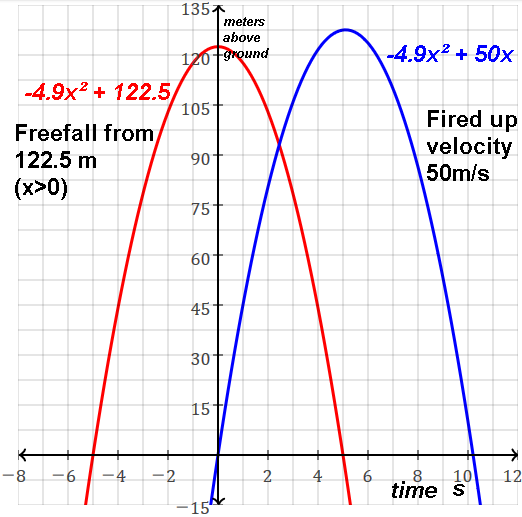
| -4.9x2 + 122.5 = 0 | -4.9 | 0 | 122.5 | two | -5, 5 |
| -4.9x2 + 50x = 0 | -4.9 | 50 | 0 | two | 0, 10.204 |
Baby number coefficients a,b,c: [-10,10] a≠0
Of the 8820 EQs, 5424 have 2 solutions, 64 one solution, 3332 no solutions
The Zero Property: If ab=0 then a=0 or b=0.
Some quadratic expressions are factorible into a pair of linear factors:
some factor over Z: e.g. x2+3x+2 = (x+1)(x+2)
some factor over Q: e.g. x2+7/6x+1/3 = (x+1/2)(x+2/3)
some factor over R: e.g. x2+4√2x+6 = (x+√2)(x+3√2)
the rest over C: e.g. x2+9 = (x+3i)(x-3i) Always a pair of complex conjugates.
e.g. x2+x+1 = (x+(1/2+√3i/2))(x+(1/2-√3i/2))
Ex. x2+3x+2 = 0 → (x+1)(x+2) = 0 and so either x+1=0 or x+2=0, which mean x=-1 or x=-2, the two solutions of the QE.
A quadratic polynomial can be factored over the integers Z if its coefficients
a, b, c are integers
AND its discriminant D = b2-4ac is a perfect square
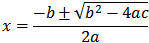
AND (-b±√D)/ 2a is/are integer(s), i.e. 2a divides -b±√D
Baby number coefficients a,b,c: [-10,10] a≠0
Of the 8820 EQs, 326 (3.7%) are factorable over the integers. "rare"
and all 326 have 2 or 1 solution.