A subclass of polynomial function
where the variable x is in the second power (i.e. squared)
(i.e. a degree two polynomial in one variable (i.e. univariate)).
a, b and c are any real numbers, a≠0 (b and/or c can be 0, i.e. they are optional).
Domain of every quadratic function is R.
Its graph in the XY Cartesian plane is a [vertical] parabola, a parabolic curve,
sort of a smooth symmetric U, bowl, wok, (golden) arch, shield shape.
Parabola is one of the conic sections (slice thru a cone),
along with circles, ellipses, hyperbolas.
The simplest curve?

Example with all the points of interest:

The lowest or highest point on the parabola,
i.e. the smallest / minimum / nadir / bottom-of-valley or
largest / maximum / zenith / top-of-hill value of the function,
is the vertex:

The x-coordinate of the vertex is -b/2a.
The y-coordinate of the vertex is the function evaluated at this x:
ƒ(-b/2a) [=c-b2/4a]
So the vertex is (-b/2a,ƒ(-b/2a))
a>0: the graph is opening upward. concave up.
Vertex's y is the absolute/global minimum
(bottom of the valley).
The two ends of the graph go up to +∞.
a<0: the graph is opening downward. concave down.
Vertex's y is the absolute/global maximum
(top of the hill).
The two ends of the graph go down to -∞

|a| is large, the sides of the curve are steep, narrow.
|a| is small, the sides of the curve are shallow, broad.
The vertex is the one turning point of the function,
the point where the function changes from decreasing to increasing,
or vice versa. The slope of the tangent line to the vertex is 0.
The vertex is either at the "top" of an infinite "hill" or the "bottom"
of an infinite "valley".
The ends of the parabola are always "widening" and never become vertical
although it might look like they are.
Parabola is symmetric about the vertical line [x=-b/2a] through its vertex:

It is self-symmetric. Bilateral symmetric.
If there is no linear term, i.e. b=0, ƒ(x)=ax2+c,
then the y-axis is the line of symmetry.
Such functions are symmetric about the y-axis, i.e. are even functions:

Another form of every quadratic function is: ƒ(x)=a(x-h)2+k
where h is the x-coordinate of the vertex, and k the y-coordinate.
h=-b/2a, k=ƒ(h) [=c-b2/4a]

Range of a quadratic function:
if a>0 then range is [k,∞), or [ƒ(-b/2a),∞)
if a<0 then range is (-∞,k], or (-∞,ƒ(-b/2a)]
Quadratic function's parabola crosses the y axis at its y-intercept: (0,c).
y-intercept is the value of setting x to be 0: a02+b0+c = c.
Every quadratic function has a y-intercept.

Quadratic function's parabola might cross the X axis at the x-intercept(s),
also called the zeroes of the function or the (real) roots of the equation.


X-intercepts' x coordinate(s) is/are the solution(s), if any,
to the quadratic equation ax2 + bx + c = 0. (i.e. y is 0)
There can be 0, 1, or 2 real number solutions:
b2-4ac is the discriminant which indicates how many (real number)
zeroes/roots/x-intercepts there are:
2 if the discriminant b2-4ac > 0
x = (-b ± √(b2-4ac)) / 2a
[quadratic formula, QF].
NB. the QF is actually two formulas, one where the ± is +, other where it is -,
for the two solutions for x.
1 if the discriminant b2-4ac = 0
x = -b/2a.
Parabola's vertex is on the X axis. The graph touches the x-axis. "perfect squares"
The function can be put into this form: f(x)=a(x-h)2, where h is the x-intercept, vertex is (h,0).
= a(x-h)(x-h), is factored, thus h is the solution, two times.
This h solution/root has multiplicity two, i.e. it is a repeated root, a double root.
0 if the discriminant b2-4ac < 0.
Parabola is completely above or below the X axis.
The quadratic equation has a pair of complex conjugates for solutions:
(-b±√+discriminant i) / 2a.
If the parabola crosses the X axis ,i.e. there are 2 x-intercepts and
the quadratic equation has 2 real roots, then
both roots can be positive, both negative, or one positive and one negative:

(The 1 negative, 1 positive case might be ± the same number viz.
when h=0, y-axis is the line of symmetry, b=0.)
x-intercepts, zeroes, roots, and factors of Quadratics:
-- 0, 1, 2 zeroes of the quadratic function. It's a function of real numbers,
so the x values that make the function value 0 are real numbers.
-- the same number of x-intercepts of the graph of the quadratic function.
The Cartesian XY plane is real numbers only. The graph only shows real number stuff,
nothing about complex numbers.
-- 0 or 2 real number roots (solutions) of the quadratic equation.
The 1-zero case is a double root, it counts as 2.
But going into the complex number system, there are always two
complex number roots (solutions), either two real complex numbers, or one real complex
number doubled, or a pair of complex conjugates.
-- 1 or 2 zeroes and x-intercepts. Quadratic polynomial (expression) can be (fully) factored to
a(x-r1)(x-r2)
r1, r2 real numbers:
r1 ≠ r2 : 2 x-intercepts, discriminant>0, 2 solutions
r1 = r2 : 1 x-intercept (touching), discriminant=0, 1 solution
-- 0 zeroes, no x-intercepts.
Quadratic expression factors as
a(x-c1)(x-c2)
c1, c2 complex conjugates
no x-intercepts, discriminant<0, "no real solutions"
Factoring quadratic expressions into a pair of linear factors:
some factor over Z: e.g. x2+3x+2 = (x+1)(x+2)
some factor over Q: e.g. x2+7/6x+1/3 = (x+1/2)(x+2/3)
some factor over R: e.g. x2+4√2x+6 = (x+√2)(x+3√2)
some factor over C: e.g. x2+9 = (x+3i)(x-3i) Always a pair of complex conjugates.
e.g. x2+x+1 = (x+(1/2+√3i/2))(x+(1/2-√3i/2))
Experiment: all 8820 quadratic EQ/Functions with integer coefficients [-10,10] (a≠0):
5424 have 2 solutions/x-intercepts, 64 1 x-intercept/solution(double root), 3332 0 solutions/x-intercepts.
326 (3.7%) are factorable over the integers Z: 274 of the 2-solution, 52 of the 1-solution, 0 of of the 0-solution.
Factorable over Z if coefficients are integers and discriminant D is perfect square
and 2a divides -b±√D.
The remaining 5424-274=5150 2-solution EQs and 64-52=12 1-solution EQs are factorable over R.
The 3332 0-solution EQs are factorable over (non-real) C.
Misc.
The sum of the solutions/roots/zeros is -b/a. The distance between them is
√(b2-4ac) /a.
Their midpoint is -b/ 2a (i.e. h, the x-coordinate of the vertex).
They are a horizontal distance √(b2-4ac) /2a from the vertex.
The product of the solutions/roots/zeros is c/a.
Dividing each term of ax2+bx+c=0 by a gives
x2+(b/a)x+(c/a)=0 which is x2-(sum of roots)x+(product of roots)=0.
The real zeros of ƒ(x)=ax2+bx+c are the negatives of the
real zeros of g(x)=cx2-bx+a
and the reciprocals of the real zeros of h(x)=cx2+bx+a
All multiples of a quadratic function have the same x-intercepts
(as all multiples of a quadratic equation have the same solutions.):

Let z1 and z2 be the two zeroes/roots (possibly complex conjugates) of a quadratic equation, then the quadratic can be written as a pair of linear factors: a(x-z1)(x-z2)
Ex. Quadratic function with the simplest complex roots:

Ex.
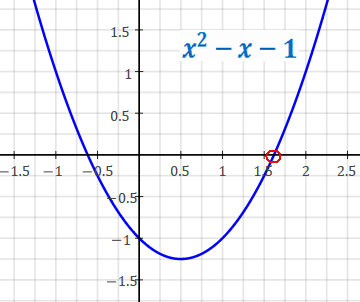
x2-x-1 = (x-φ)(x-(1-φ)) 2 solutions: φ and 1-φ
The focus of the parabola is a point on the axis of symmetry
(i.e. same x as the vertex) that is 1/(4a) away: (-b/2a,(4ac-b2+1)/4a)
It's in the concave bowl.

If the parabola can reflect light/radio/sound/particles, then that stuff which travels parallel
to the axis of symmetry and strikes its concave side is reflected to the focus,
concentrating there.
Conversely, stuff that originates at the focus is reflected
into a parallel beam, i.e. it can be "aimed" (gain).

This property is used in reflecting telescopes, searchlights, flashlights,
headlamps, solar cookers, satellite dishes, parabolic antennas.
A parabola rotated/spun 360° forms a 3D surface called a paraboloid.
A geometric definition of parabola as a conic section.


