Trigonometric function graphs
periodic, cyclic, repeating
click for larger image file.

SOH CAH TOA:

In a right triangle, if know angle α and length of one side
can find the length of another side using a trig function of the angle
(and length of 3rd side either with Pythagorean theorem or a trig function using the other angle
β=90-α):
--if know Opp: sin α = Opp/Hyp → Hyp = Opp/sin α
--if know Opp: tan α = Opp/Adj → Adj = Opp/tan α
--if know Adj: cos α = Adj/Hyp → Hyp = Adj/cos α
--if know Adj: tan α = Opp/Adj → Opp = Adj · tan α
--if know Hyp: sin α = Opp/Hyp → Opp = Hyp · sin α
--if know Hyp: cos α = Adj/Hyp → Adj = Hyp · cos α
Ex. If know distance adj to pole, tower, cliff, bldg. etc. and angle a to top of the pole,
then the height opp of the pole is adj · tan a
[and the distance hyp to top of pole is adj · sec a]
In a right triangle, if know the side lengths, can find an angle using
an inverse trig function:
sin α = Opp/Hyp → α = asin Opp/Hyp
cos α = Adj/Hyp → α = acos Adj/Hyp
tan α = Opp/Adj → α = atan Opp/Adj
Ex. Opp=2, Adj=3 → α = atan 2/3 = 33.69°
In a non-right triangle, can "solve" it using
Law of Sines or Law of Cosines.


The co- functions are the corresponding trig function of the complement of the angle:
cos(a) = sin(90-a)
cot(a) = tan(90-a)
csc(a) = sec(90-a)
sine is the fundamental function, all others can be drefined in terms of it:
cos(x) = sin(x+π/2)


360° / 2π radians = ~57° / 1 radian
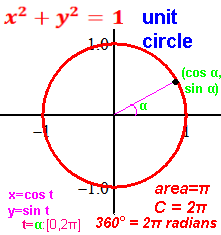
Unit circle: center angle in radians equals arc length
Unit circle: sector of central angle 1 radian has area 1/2
| Degrees °
| a Radians
| x = cos a
| y = sin a
| x2+y2=1
| slope of tangent line = - 1 / tan a = -cot a
|
| 0
| 0
| 1
| 0
| 1+0
| ∞
|
| ~14.47
| ~.2527
| √15/4 ≈.968
| 1/4=.25
| 15/16+1/16
| -√15 ≈-3.873
|
| 15
| π/12 ≈ .2618
| (√6+√2)/4≈.966
| (√6-√2)/4≈.258
| .933+.0667
| -(2+√3) ≈-3.732
|
| 30
| π/6 ≈ .5235
| √3/2 ≈.866
| 1/2=.5
| 3/4+1/4
| -√3 ≈-1.732
|
| ~35.26
| ~.6155
| √2/√3 ≈.816
| 1/√3 ≈.577
| 2/3+1/3
| -√2 ≈-1.414
|
| 45
| π/4 ≈ .7853
| √2/2 ≈.707
| √2/2 ≈.707
| 1/2+1/2
| -1
|
| ~54.74
| ~.9553
| 1/√3 ≈.577
| √2/√3 ≈.816
| 1/3+2/3
| -1/√2 ≈-.707
|
| ~57.29
| 1
| ~.5403
| ~.8414
| .2919+.7079
| ~-.642
|
| 60
| π/3 ≈ 1.047
| 1/2=.5
| √3/2 ≈.866
| 1/4+3/4
| -1/√3 ≈-.577
|
| 75
| 5π/12 ≈ 1.309
| (√6-√2)/4 ≈ .2588
| (√6+√2)/4 ≈ .966
| .067+.933
| -(2-√3) ≈-.268
|
| ~75.52
| ~1.318
| 1/4=.25
| √15/4 ≈.968
| 1/16+15/16
| -1/√15 ≈-.258
|
| 90
| π/2 ≈ 1.571
| 0
| 1
| 0+1
| 0
|
change in sine every 15°
|
| 0°
| 15°
| 30°
| 45°
| 60°
| 75°
| 90°
|
| sine
| 0
| .258
| .5
| .707
| .866
| .968
| 1
|
| Δ
|
| .258
| .244
| .207
| .159
| .104
| .032
|


First and second derivatives of sine function:


First and second derivatives of tan function:


hyperbolic sin and hyperbolic cos:


f(x) = sin(ax) + sin(bx)
No period if a or b irrational (and if both irrational, not rational multiples of each other).


