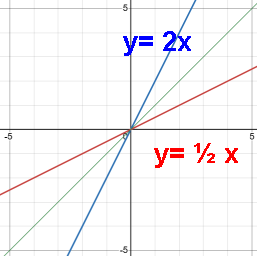
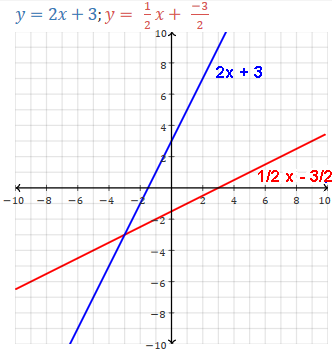
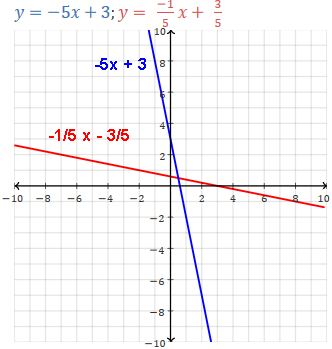
A pair of inverse functions are reflections of each other across
(are symmetric about) the main diagonal y=x.
Their point of intersection is on the main diagonal y=x;
its x and y coordinates are b/(1-m).
Linear inverses swap their x and y intercepts.
A function can have only one inverse (if it has one at all [the function has to be monotonically increasing or decreasing, i.e. it has to pass the horizontal line test (no horizontal line can touch the function's graph more than once), the function is one-to-one]; every linear function has an inverse.
y=x and y=-x are their own inverses.
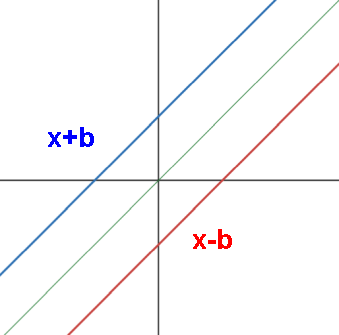
Inverses but no intersection point: